
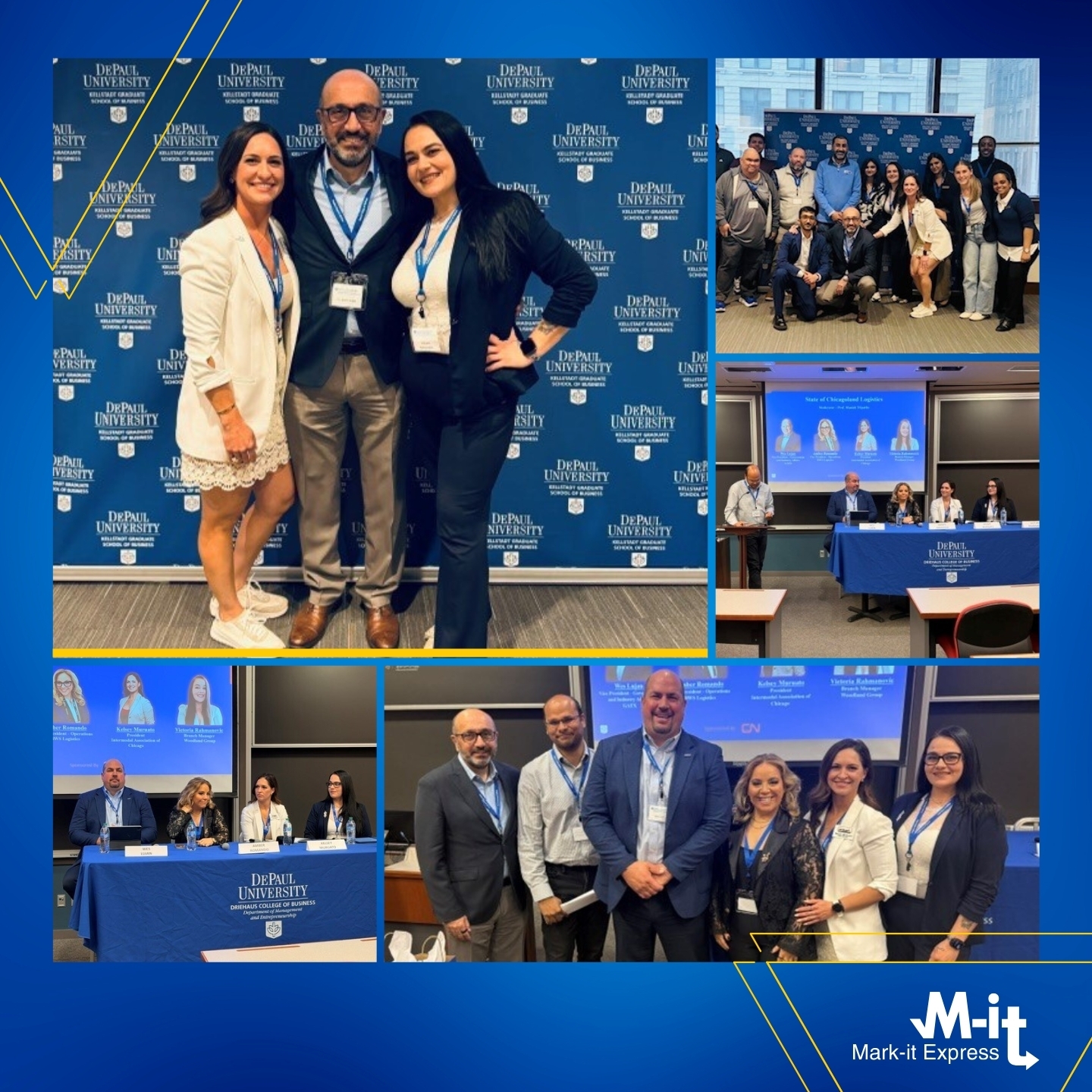
By Kelsey Muruato, Mark-it Express
When I was invited to speak on a panel at DePaul University’s Chicagoland Supply Chain Forum, my first thought was somewhere between excited and okay, don’t embarrass yourself. I spend most of my time in sales, talking to shippers and carriers about drayage, intermodal, and how to keep freight moving efficiently through the Chicagoland corridor. Standing in front of a room of supply chain students is a different kind of conversation. A good one, it turns out.
My panel was called “State of Logistics in Chicagoland,” and it was exactly the kind of conversation I genuinely enjoy — grounded, direct, and honest about what’s working and what isn’t.
Here’s what we covered, and what I’d add now that I’ve had time to sit with it.
Chicago Isn’t a Seaport. That’s Actually the Point.
A lot of people hear “port” and think coastal — Long Beach, Savannah, Houston. Chicago is different. It’s an inland port, and what makes it powerful is how it was built to function: as a place where maritime, rail, and truck networks meet and hand freight off to each other. That’s not incidental. That’s the whole design.
The health of Chicagoland logistics is good — not because things have been smooth, but because the market here has learned to adapt. Post-pandemic supply chain disruptions didn’t come with a playbook. Geopolitical pressures, labor strikes, changes in vessel routes, capacity shifts — these aren’t one-time events anymore. They’re the rhythm of the market. The question isn’t if disruption will happen. The question is how quickly you can respond when it does.
At Mark-it, that question shapes how we operate every day. We run an asset-based model — our own trucks, our own drivers, our own yards — because when things go sideways, we need to be able to move without waiting for permission from someone else in the chain.
The Infrastructure Investments Worth Watching
One of the things I appreciated about the panel was the focus on what’s actually being built and funded in this region, not just the theoretical future of logistics. Fellow panelist Erin Aleman, Executive Director at the Chicago Metropolitan Agency for Planning (CMAP), brought a regional planning perspective that grounded the conversation in real investment. A few things stood out:
The CREATE Program. Erin highlighted this long-running Illinois initiative — more than 20 years in the making — focused on expanding railroad terminals and reducing the congestion that builds up where rail lines converge in the Chicago region. Anyone who’s watched a train sit and wait in a Chicago rail yard knows this isn’t a theoretical problem. CREATE is trying to solve it systematically.
The Illinois International Port District. Also raised by Erin, this is the infrastructure connecting freight movement across the Great Lakes region — a piece of the logistics picture that doesn’t always get enough attention in conversations focused on rail and truck.
BNSF’s $3.6 Billion Capital Plan. BNSF announced a major investment for 2026, and their Chicago terminals are part of it. Expanded terminal capacity and improved efficiency directly affect how quickly intermodal freight moves through the region. For drayage carriers like us, terminal fluidity isn’t abstract — it’s the difference between a smooth pull and a container sitting for two days.
The 75th Street Corridor. If you work in Chicago logistics, you know this bottleneck. It’s arguably the most important freight infrastructure project in the region, and it’s finally moving. The improvements are designed to address freight and passenger congestion, reduce interchange delays, and increase overall capacity. This matters.
CPKC. The proposed transcontinental merger is now a reality. Canadian National, U.S. networks, and Mexico — connected as a single service lane. The investment in yard and lot expansion, combined with better technology for terminal fluidity, should eventually mean more streamlined cross-border intermodal options. We’ll see how it plays out operationally, but the intent is there.
“Chicagoland has the infrastructure bones to remain one of the world’s great freight and logistics hubs. But our future competitiveness depends on the choices we make now: how we plan, how we invest, and how well we work together to turn plans into progress.”
— Erin Aleman, Executive Director, Chicago Metropolitan Agency for Planning (CMAP)
That framing stuck with me. The investments are real, but they only move the needle if the region follows through — and that’s not guaranteed.
Technology: What Customers Are Actually Asking For
The panel had a dedicated session on AI and technology, and I’ll admit — I didn’t get to say everything I wanted to in the moment. So here’s the longer version.
Customers aren’t asking for technology for technology’s sake. What they want is visibility, reliability, and risk mitigation. The tech that earns attention is the tech that delivers on those three things.
What that looks like in practice:
- Container and vessel tracking that gives real-time location, not a guess
- Demurrage alerts and ETA predictions before surprises hit the billing cycle
- Lot and container sensors for cargo condition monitoring (and yes, cargo theft is on the rise — this is a real operational concern)
- AI-assisted demand forecasting and inventory management on the customer side
- Appointment scheduling at ports and rail terminals (both are increasingly implementing structured arrival windows)
- EDI and API integration so status updates flow between parties without someone manually emailing a spreadsheet
What I’d add from our own experience: the technology is only as useful as the humans behind it. We use tools to give customers better visibility, but the reason freight actually gets where it needs to go on time is because our dispatch team, our drivers, and our leadership are reachable and accountable. Tech should support that — not replace it.
The Real Threat: Volatility Without a Plan
The biggest ongoing challenge in this market isn’t any single disruption. It’s the compounding effect of volatility that never fully settles.
Geopolitical instability. Labor disruptions. Infrastructure bottlenecks. Shifting trade routes. These aren’t occasional headaches — they’re structural. And for supply chain teams that are trying to plan months out, the uncertainty makes everything harder.
What I said on the panel, and what I believe: the companies that navigate this best aren’t the ones with the most complex contingency plans. They’re the ones with flexible, multi-modal networks that can respond quickly when the plan changes. For us, that means deep relationships with rail, chassis pools, depot operators, and regional contacts — so when something shifts, we’re already a few steps ahead of the disruption.
Can Chicago Keep Its Edge?
This was the part of the panel that seemed to spark the most conversation with the students in the room, and I think it’s because the honest answer is: yes, but not automatically.
Chicago’s strength has always been its connectivity and scale. But as reshoring and nearshoring continue to change where manufacturing and distribution are based, companies may increasingly look at regions with lower costs, faster permitting, or proximity to their end markets. Dallas, Phoenix, Kansas City — these markets are growing in their logistics capabilities, and it’s worth paying attention to.
Chicago doesn’t hold its position by default. It holds it through infrastructure modernization, operational fluidity, and the carriers and truckers who make the system actually work on the ground. That’s not a small thing. The people moving freight through Chicagoland every day — including our drivers — are part of what keeps this market competitive.
If we let infrastructure fall behind, or if the regulatory and congestion pressures get heavy enough that carriers start routing around Chicago rather than through it, we’ll feel that shift. The investments being made in the 75th Street Corridor and the BNSF terminals matter precisely because of this.
What I Took Away From the Room
I’ve been in logistics long enough to know that the most valuable industry conversations aren’t always the formal ones. What I appreciated about this panel was the students — they were asking real questions, not softballs. They wanted to understand the complexity, not just the elevator pitch.
That’s a good sign for the next generation coming into this industry. And it reminded me of something I think about at Mark-it all the time: the best thing you can do for a customer, or a student, or a colleague, is be honest about what’s hard and specific about what works. That’s how trust gets built. Not through glossy talking points.
Chicago’s logistics story is a good one. But it requires people who actually know the operation — not just the theory — to keep telling it.